16.8.12

Long Valley Rice Harvesting Workcamp (5) - Free days


Just before the typhoon Vicente came on Sunday, it was the free days for all the campers.  I invited the six of them to have a holiday in my house on Cheung Chau island.  It was already typhoon signal number 3 in the afternoon, but as the wind was not so strong, the weather was still not bad with only little rainfall, so we went straight away to have fun on the beach. 

Holiday!

A cloudy day was really a good day on the beach, we didn’t even need to use sun block cream.  After we rented a volleyball from the shop, we started to play the once popular game when I was in secondary school—the number ball game.  Though this game was really simple, it bought us so much joy and laughter.  The best time was watching the shows of those who lost the game, starting from dancing performance from Russia, Korea and France, and last but not least, the Hong Kong sexy dance.  Finally, as Get from France who had lost so many rounds, she even needed to use Cantonese to ask a Hong Kong guy his name in front of his girlfriend, as well as to borrow the cap from a Hong Kong guy who was watching our game all the time.


Punishment!  Get became a mermaid!

Punishment again!  Get was asked to borrow the cap from a local guy.
When we were buying souvenirs on the way to the ferry pier the following day, the staff of CA, Jin Pan called me that typhoon signal number eight would be hoisted in the evening, so instead of going up to the peak to see the skyline of Hong Kong, we went for a hike on Cheung Chau under the rain.  As you know, we were all wild beasts, so the most important thing for us to do in these two days was eating!  I brought them to local tea restaurant, outdoor food stall, Shanghai restaurant, Chiuchow noodles and the most local sweet soup shop.  We even visited the same sweet shop three times in two days, even the young staff in the shop was amazed by our frequencies of eating sweet soup.

Though my house is small, it could still fit 7 of us.

In fact, because we taught the Korean volunteer, Tree to say ‘Leng zai’ (means handsome guy) to please the staff there, it also became the highlight of their days.  They even took a peek in her iphone to see her Facebook’s username.


Tree loved the local Hong Kong sweet soup very much.

In fact, because we taught the Korean volunteer, Tree to say ‘Leng zai’ (means handsome guy) to please the staff there, it also became the highlight of their days.  They even took a peek in her iphone to see her Facebook’s username.

Many friends who had visited my place, often asked the same question when they were standing on the balcony, looking at the 180 degree seaview, ‘How would that be if it would be typhoon signal number eight?’  The fact is that we didn’t even know that it was signal number 10 as it was too quiet outside!  Why was it so?  Since my house was facing north west, and the typhoon was coming from north east this time, and there was a hill behind protecting us from the wind, so even though the wind speed had reached 200KM per hour on that night, we were sleeping like pigs!  Only until the next day, then we knew it was typhoon signal number 10!


When we walked out of the house, we finally saw the destructions of this super typhoon that there was a railing on the rooftop of a house was bent because of a falling tree, a canvas rooftop was blown on the pedestrian way and many trees were uprooted.  I was feeling so grateful when I heard that the canvas rooftop on our little house in Long Valley was blown off, leading to water leakage in the house.  We were so lucky that we could stay in a safe place during this typhoon.


The destruction after the typhoon signal no. 10.


The destruction after the typhoon signal no. 10.

As a result, we again stayed in Cheung Chau for an extra night.  Since we were trapped indoor by the rainy weather, this group of volunteers was so hard-working that they turned this workcamp into a language exchange camp, from Indonesian, Russian, Korean, French to even Cantonese.  Hearing them bla bla bla for the whole day just like parrots, thanks for them, I know if I would be cast away in Indonesia one day, I would still know how to show my love and even propose to an Indonesian man!

When it was raining after the typhoon had gone, we visited the local farmer, Mr Lam and his wife, we cooked and had lunch with them.  Although they were already over 80 years old and owned a big family with four generations, they were still so strong and healthy.  Whenever we saw them bending their waist and working under the hot sun, and  we looked at ourselves—half-lying under the tent, almost dying after the work, we were always feeling a profound respect to them.  I think the quote from Dima’s grandmother best described the situation, ‘We started working in the field when we were very young and we are still very healthy today, we can walk and we can even run.  But look at the young people nowadays, why are they feeling pain everywhere in their bodies?’


We were like the grand children of Mr Lam!

13.8.12

Long Valley Rice Harvesting Workcamp (4)—Food


I believe that eating is the biggest hobby of all of us during the workcamp.  Starting from morning till the night, we were always eating.  Especially everyday only after working for one hour in the morning, Tree  from Korea would tell us that she was hungry.  Though others didn’t say anything, if you see how fast and how much quantity of food that we ate in every meal, you would know that how hungry was this group of wild beasts.

Dinner time!


A characteristic of workcamp is that volunteers are always responsible for all the meals, so everyone can always enjoy the delicacies from all over the world.  Our food varieties were so wide and broad, from the Russian mixed veggie soup, the French crepe, the Korean bibimbop, the Indonesia baby food porridge and the Hong Kong fried eggs with tomatoes and tofu mixed veggie soup.  Eating, was definitely our biggest enjoyment after a day of hard work.


Tree from Korea was preparing the dinner.
A unique or challenging characteristic of this workcamp was that, I was the camp leader and I had a very specific diet.  Those who know me well know that I am almost a vegan, I don’t eat fish, meat and eggs, and almost no dairy products (except the Indian Ghee which is clarified butter).  For the benefits of meditation, I also don’t eat five kinds of strong smelling vegetables (eg garlic and onion).  I don’t take any drinks which have caffeine and I don’t take alcohol.  In order to help in digestion, I don’t drink right before, during and after meals.  And, I am allergic to mango.

We always went to the Sheung Shu wet market to buy food together.

Beside me, Rice from Indonesia is a devoted Muslim, so he doesn’t eat pork and doesn’t take alcohol as well.  And this workcamp just coincided with the once a year Ramadan, so he would only eat and drink before sunrise and after sunset.

Rice from Indonesia drank his first sip after a whole day of fasting.
On the contrary, there was a ‘carnivore’ among our volunteers--Ben from Hong Kong.  He said he didn’t eat any vegetables except broccoli, and he ate meat in every meal.


So you can imagine, there would be so many jokes coming out among us in this period.

The most classical one was that on the first dinner after a day of work, it was Ben and Rice responsible for the meal.  As I knew Ben well, so I kept reminding him to cook something for me while we were buying the food and even during he was cooking.  Unfortunately, as there was a miscommunication between him and Rice, so the only vegetable dish on the disk was cooked with garlic!


Thanks Get for making vegan crepe for me.
Then the next day, it was Candy from Hong Kong and Dima from Russia responsible for the cooking.  As Candy kept reminding herself that what I didn’t eat, so she finally forgot that Rice didn’t eat pork!  Luckily, Rice didn’t mind to eat the vegetarian dish with me.

Except cooking team, others were in the cleaning team, responsible for washing dishes and cleaning the floor.

On the first day when Rice observed Ramadan, the weather was super hot and sunny.  We had worked under the sun for half of the day, I found that Rice was very slow and tired, I thought that he must be very hungry.  Only until when I reminded him to drink plenty of water in the afternoon, then I was shocked to know that he couldn’t even drink any water during the fasting period!  My negligence was all because I was used to the fasting way of Hindu, which allowed drinking water.  Oh my god!  Luckily, he also thought that it was a very dangerous way of fasting, so he decided to postpone the fasting days.

Finally on the last day of workcamp, Rice still put chicken powder into the tofu mixed veggie soup carelessly…And when we were eating out in the Sheung Shui cooked food center, I forgot that there was pork in the dishes of omelette rice, Singapore style fried rice, sweet and sour pork and barbecue pork!


Lunch time!  There were only six people, because Rice was fast, so he would hide himself inside the house whenever it was the meal time.

8.8.12

Long Valley Rice Harvesting Workcamp (3) — Accommodation


One of the characteristics of this workcamp was to promote low carbon’s life, so even though the simple tin house we stayed in was as hot as Sahara Desert in the midday, there was no air-conditioner.  However, we did have three big strong fans and a windy balcony.  When it was unbearable hot in the afternoon, we liked to take the fans to the balcony and slept on the chairs.  In fact, once you get used to the temperature of nature, living without air-conditioners is far more comfortable than always entering and exiting air-conditioned rooms.

The simple little hut that accommodated all volunteers.

Naping on a chair with a strong fan amid the boiling hot weather.


From this experience, I was deeply impressed by the traditional wisdom.   The house we stayed in was also called, ‘Long leg house’ because it was elevated a few feet by several long legs.  The extra area under the house was used to store things and its heat-dissipating function did impress me.  There were several nights that I felt so cold that I needed to turn off the fan and covered myself.  The room temperature inside was indeed much lower than outside, just like we had turned on the natural air-conditioner.

The long legs help to elevate the house, dissipating the heat.

Another characteristic of this workcamp was that we were not served with high beds and soft mattresses, so we had to sleep on our own yoga mat and heat-dissipating bamboo mat.  The thing I loved most was the big mosquito net which was provided by CA, this net made me feel like a princess, in addition to prevent the attack from insects, that transparent space did give us a sense of privacy.

Everyone had their own privacy inside these princess-felt mosquito nets.

As we just stayed beside the farms, all the detergents we used were biodegradable and natural so as to reduce our harm to the fragile environment around us.  For example, we used tea seed powder liquid to wash dishes, soap nut liquid for shower and laundry and citronella oil as insect repellent.  Only until I did the research about natural detergent online before the workcamp, then I knew nature had long provided everything we needed around us.  In fact, it is so easy to stay in harmony with nature, it all depends if you have the heart to discover the way.

This small nut is called Soap nut, its shell easily get bubbles when you rub them, it is the most natural detergent on earth.

This kind of simple life is not unfamiliar with me, because I had lived in villages close to farmlands, tin house without long legs (the boiling hot feeling inside the house was still unforgettable) and I was also used to the simple life in the ashram in India.  However, the biggest challenge was bitten by unknown insects while I was sleeping and annoyed by the rat who kept grounding his teeth while we were on bed.  Actually I didn’t’ mind to be strung by mosquitoes and those smaller than sesame blood-suckers ‘aat zai’, because at least I could see them.  Until now, I still don’t know what kind of insects who stung my feet at night and made me feeling crazily itchy, some said they were fleas, some said mites, some even said spiders.

My piggy foot after stung by red ants and unknown insects.


In fact, why do human beings are dying to kill snakes which they encounter?  If you didn’t hurt them at the first place, they would rather ignore you; why do human beings have to catch bullfrogs to eat?  They are indeed helping us to eat lots of mosquitoes; why do human beings are desperate to attack those ugly flying insects?  They are just lost and fly into your home accidentally.  Therefore, I didn’t hate those insects who stung me because I understood very well that it was me who invaded their habitat, but not they invaded my mosquito net.

We were living with different kinds of insects in Long Vally, eg, very often, we found this beautiful Rhinoceros beetle.

This little long leg house not only provided us a shelter, but also acted as a bridge between nature and us.  My favourite moment was just before dawn, when the eggplants and water spinach were in deep sleep in the farms in front of the house.  Then when the first ray of sun showered on the leaves, the just condensed dew water would reflect the golden rays of the sunrise, the sprinkling colour from the farms was just like saying good morning to me.

At night after the twilight, looking out from the house, it was the dark farms with a row of rectangular shining objects on the top left corner, their light scattering through the sky, that is the civilization of the Sheung Shui town center.  But if you shifted your look to the right, you would only see the darkness, some branches dancing under the breeze and hear the frogs were contending among each other, that is the motherly tenderness of Long Valley.

From the quiet darkness of Long Valley, watching the dazzling city.

How long can such peaceful moments last for?  The Hong Kong government has already planned to develop the surrounding area of Long Valley into residential area.  Can the future residents keep the harmony with the wildlife here?


Long Valley Rice Harvesting Workcamp (2) — Work


CA does not only reintroduce cultivating rice in Long Valley, but also reintroduces the most traditional way of rice harvesting.  Different from using a lot of machines, this kind of rice harvesting method needs lots of manpower, and that’s why I understand Chinese used to have such a big family with 10 brothers and sisters.

First of all, we had to bend down or squat down and used the sickle to cut away the rice plant.  Before working here, I always thought that it would be very easy and quick to harvest all the rice, we wouldn’t need two weeks for that.  Only until I started to work, then I realized that ‘rice harvesting’ was not only about cutting away the rice.

All volunteers were working very hard.

Second, we utilized the manual stepping husking machine which was made by the students of De La Salle Secondary School in Sheung Shui to husk all the golden rice, then we also needed to put the husked rice plants aside on the path.

Some were responsible for husking, some helped in picking up the husked rice plants.

I thought it was the end, but in fact after husking, the CA staff Mr Kan who was instructing us for the rice harvesting work then took out a big fan and he hanged a big bamboo sieve on a bamboo tripod.  We then poured all the husked rice onto the bamboo sieve, so the fan would blow away the empty husk and straw away from the rice.  At the same time, we would be sitting on two side of the tripod, picking away the mud, little snails and beetles from the pile of rice.

Blowing away the empty husks and picking away the impurities.

I thought it was the end again, surprisingly I saw Mr Kan took out a few pieces of big canvas and he spread them out on the rice field.  In fact, we were going to dry the filtered rice under the sun, we even needed to turn around the rice after half an hour.

Drying the rice.


It was still not the end, but as there was no rice grounding machine in Long Valley, so CA would then take the dry rice to Nam Chung to ground them.  After packaging, the rice would then be transported to the organic greenshop in Wan Chai for sale.

Once we cut the rice, they had to dry them immediately, otherwise they would turn rotted because of the humidity.  As a result, every time when we started working, we had to calculate how much rice needed to be cut and it all depended on the weather and man power, otherwise, we would lose more than what we would have cut.

On the first day of work, as I didn’t know the habits of all the local and overseas volunteers, and I also considered that for those who had just arrived Hong Kong might have jet lag, so I suggested that we would start our work at 8.30am, and it would be at 7.30am on the following days so as to stay away from the hot sun.  It was surprising for me that after working under the hot sun on the first day, the volunteers suggested that they would rather start the work at 6am.  I was really happy for this suggestion because I was used to get up early to do meditation, yoga and Taichi.  Later, it proved that this was the most effective and comfortable way to work in the field.  For example, the weather was extremely hot and stuffy before the typhoon came, but as we started to work at 6am, and we finished our work before 10am, which was quite hot already, so actually our productivity of that day was the highest--we had harvested 7 bags of rice in that morning.

Not long after sunrise, we set off for work.

While I was harvesting the rice, an old poem kept popping into my mind, which was, ‘Hoeing the field in the midday, sweating on the rice field, who would ever know that every grain in the meal counts.’  I was not kidding, only by working here for half day, I had already experienced the meaning behind this poem.  Although I never like wasting food, this volunteer project really reminded me to respect our mother earth and all the superman farmers!

Unfortunately, this rice harvesting period had coincided with the super strong typhoon Vicente, it was already 13 years ago that Hong Kong had hoisted typhoon signal number 10.  All the rice was kind of destroyed by the strong wind, if not, they were also started sprouting because of the heavy rain afterwards.   Therefore, we needed to cut away all the rice in the muddy field and threw them away as rubbish.  It was believed that the produce this year would only be one fourth of last year!

Seeing such kind of natural disasters, human beings are totally impotent.  What we can do is just to accept and understand the importance of living with the flow of nature.

As we had plenty of rain this year, rice harvesting period actually had started much earlier, and we could then also help to transplant the rice seedlings, which was a nice surprise.  In fact, the farmers had planted the rice seedlings on the edge of the rice fields, our work was to uproot the rice seedlings, stepped in the knee-height ‘swamp’ and then transplanted the rice seedlings one by one.

Everyone was ready to transplant the rice seedlings.

Transplanting rice seedlings was not as sweaty and tough as rice harvesting, but it really tested the strength of our waist, our eyes and our patience.  And I realized that it was very difficult to transplant the rice seedlings in a straight line!  And we even transplanted them too densely that there were not enough rice seedlings for the other rice fields!

The side effect of transplanting rice seedlings was that I could still feel like my legs were soaking in the mud even after a few hours!

Our French volunteer, Get, used mud from the rice farm to put on her legs as sun block.

Besides, when it was raining for a few days after the typhoon had gone, we helped to remove the old paint from the house we stayed, repaint it with a new colour and helped to remove the lotus seeds from their husks.  Although they were indoor works, very relaxed and we didn’t need to be under the sun or rain, I would rather sweat on the golden rice field under the hot sun, frightened by the bamboo snake in the field, attacked by the red ants which were living inside the rice field or even fell into the muddy field when it was raining.

Unconsciously, I have developed a deep connection with this piece of land, the feeling is just like falling into love.  When I was looking at it quietly, there would be the blossoming of smile and love from my heart;  When I was stepping on it firmly, I felt totally alive and full of joy;  When I was running across the fields, I felt like I was flying over the clouds.  Although I was bitten by red ants, making me scratching crazily for the whole nights and my foot was swollen like that of a pig, I felt totally grounded and safe, I even thought, ‘Now I know it was like this to be bitten by red ants.’  This is the balanced feeling of living in harmony with nature.  Not resisting, accepting everything life gives you and you will be rewarded with its unlimited love and bliss.

The unifying scenery of the sky and water in Long Valley.

Long Valley Rice Harvesting Workcamp (1) — Background


Long Valley is the largest agricultural freshwater wetland (the total area is 150 hectares) with over 500 years of agricultural history.  Many years ago, it was in the spotlight because the Hong Kong government was planning to build a train line across this piece of wetland.  Finally, environmental groups in Hong Kong won the lawsuit and Long Valley has then been preserved for conservative purposes.

 The greenery in Long Valley.

Hong Kong is famous for its concrete forest and being a financial centre, no one can ever imagine that there is such a big piece of agricultural land.  In fact, every inch of land is so precious in Hong Kong, and it is much cheaper to import vegetables and rice, who knows that there is still rice planting in Hong Kong?  It is all because of our environmental organization, Conservancy Association (CA), which reintroduces rice planting in Long Valley, so different species of frogs and birds can have their habitats here.  At the same time, local people can also contribute by volunteering and gain knowledge about Hong Kong agricultural history, ecology and they can also educate the young generation that rice is not coming from supermarkets.

 The golden rice field waiting to be harvested.

In June every year, it is the rice harvesting period.  Rice harvesting can only be done on sunny day, because the wet rice can easily become moldy if it gets wet.  Local volunteers can only come on Saturday, Sunday and holidays, if it rains on these days, the rice harvesting activity has to be cancelled.  As a result, CA cooperates with Hong Kong volunteering organization Voltra, recruits local and overseas volunteers to stay in Long Valley for two weeks, so as to speed up rice harvesting work.

Local farmer, the lovely childlike 82 years old Mr Lam!

This is the second year that CA and Voltra hold such a rice harvesting workcamp.  As I just came back Hong Kong and have plenty of free time, also I love nature and would like to learn about rice cultivation, so I became the camp leader of this workcamp.

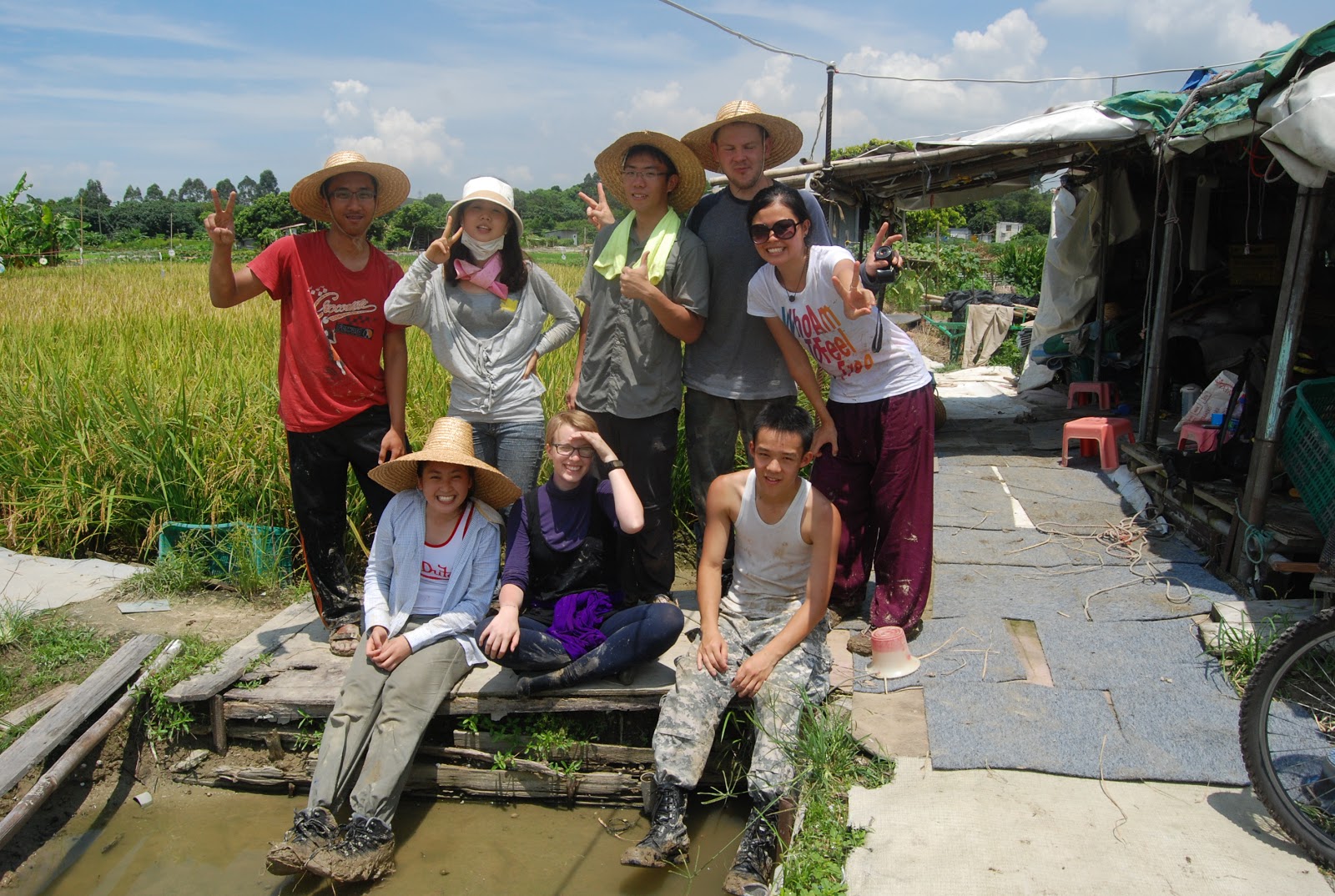
During the period of 18th to 31st July, 2012, together with Estelle (whose nickname is Get—pronounced as Jet) from France, Dima (Forest) from Russia, Hyorin (Tree) from Korea, Audia (Rice) from Indonesia, Candy (Watermelon) and Ben (Mountain or Uncle Ben) from Hong Kong, we experienced a very tough work (totally not exaggerated) in rice harvesting, the adventurous typhoon no. 10, battles with the cunning rat, mosquitoes and red ants.  However, we are like wild beasts that we enjoyed the process so much that we sang and danced every day and we did eat like wild pigs, swallowing tons of food in every meal.

The crazy wild beasts.

I realized that I love this kind of farmer’s life very much, rising up with the sun and finishing the day along with the sunset.

Life, can be really really simple, but sweet.


(To be continued…)


2.7.11

The story of Edventure Nepal

In order to let more interested people to know about the orphanage easily, I had interviewed the members of Edventure Nepal. So when some volunteers would make a website for them, the articles can be put on there. During the interviews, I was deeply touched by the innocence of the children and also by their determinations to contribute to the society. Although they are living in one of the poorest countries in the world and they all have their heart-breaking stories to tell, their determinations of humanitarian work are indeed much stronger than many people who are living in any developed countries.  

Amrit, Chairman of Edventure, 27years old A simple man with high thinking

The seed of starting an orphanage in Nepal has long been planted in Amrit’s life.

When he was 18 years old, his father suddenly got cancer. With limited income, he had to drop out from school and worked as a teacher in a remote area in Kaski District(near Pokhara), so as to support the enormous expenses of his father’s medication. For 2 years, he and his sister were taking care of his father in the hospital. Nonetheless, his father still passed away painfully at the end.

During the time he was working in the village, daily stricken by seeing the suffering of his father and the condition of the poor children, he started to think about what he could do to help all those children.

After his father had passed away, he started working full time as a teacher in Pokhara, so as to pay off the tuition fees of his bachelor degree. In this school, he met Tulasi (the vice-chairman of EdventureNepal) who was a cleaner at the school. The fact that Tulasi was tortured by her ex-husband a lot struck him a lot. He was always trying to help Tulasi in the school kitchen and walking her back home in the late evening.

With all the compassion towards the misfortunate situations of Tulasi and the underprivileged children in the village, he realized that if he only worked as a teacher, receiving a very low pay each month, was not enough to help others than himself. So he left for Kathmandu to work in a travel agency which also had supports to an orphanage. From there, he learnt a lot about how to run a non-profit organization.

In the meantime, his sister was diagnosed with kidney failure. In the fear that he would lose another family member, he quit his job, together with his brother-in-law, they took care of her for months and they even went to India to search for better medication. To their greatest relief, his sister’s situation started to turn stable. He was relieved and went back to Kathmandu.

With no job, but bills to pay, he was thinking about his next move. The dream of starting an organization which helped poor children and Tulasi in his home town, Pokhara appeared to him again. With the advices of his brother-in-law, who worked in the Nepal Tourism Board in Kathmandu, he managed to register Edventure Nepal successfully in April, 2011.

He and Tulasi then rescued the 3 sisters Tulasi, Yemuna and Ganga, together with Tulasi’s daughter, Laxmi, 6 of them are now living in the orphanage in Pokhara.

With compassion, inner strength and implementing what he learnt, he would like to grow Edventure Nepal step by step and leads it to be one of the leading non-profit organizations in Nepal. Hopefully in the future, he could travel to other countries, except seeing the world to broaden his horizon, he would visit other non-profit organizations and be inspired by them, so he could implement the new ideas in this orphanage. In this way, they could uplift more and more underprivileged children and let them be the change of the future world.

Tulasi, Vice-Chairman of Edventure Nepal, 35 years old A tough woman with a tender heart

In Nepal, a country which is dominated by male, women always lack of care and supports. One may wonder, why Tulasi, an illiterate mother of 3 children is so devoted to work in this charitable organization, even though she needed to do hard labour to support the orphans’ living at the beginning.

It is all because of her similar childhood background and her unfortunate marriage. When she was a girl, her father married another woman. Since then, she had no more love and affection from her father and she was deprived of education opportunities.

When she grew up, she was first living with her sister and her brother-in-law as her parents couldn’t support her living. She wanted her marriage to be arranged by her father, but he didn’t even care about Tulasi at all. Finally, her brother-in-law arranged a marriage for her. Only when she got married, she found out her ex-husband happened to be neurotics and violent. All the three children were not conceived under her free will, they all happened when she fell unconscious after severe beating from his ex-husband. His ex-husband was always hitting Tulasi with his hand or kicking her with his leg without any reasons. He even tried to strangle his own baby when he was drunken. Shocked by this incident, she finally made the decision to leave her ex-husband with her children, and started to work days and nights as a low-skilled labour. Because of that, she got a permanent damage on her spinal cord and often suffers from great pain.

With the help of Amrit, her two sons were sent to a well-established orphanage in Kathmandu. Relieved to see that her sons are under good care and protection, she realized that a good orphanage can really change the lives of underprivileged children, so she would like to help other similar children with her love and cares.

Tulasi is devoting her time days and nights in the orphanage, she would love to see Edventure Nepal blooming, helping more underprivileged children with a bigger and bigger international network. Personally, she dreams to see and travel around the world, especially doing a pilgrimage to the ashrams of Amma and Sai BaBa in South India.

Laxmi, 15 years old A humble and loving young lady

She is the daughter of the Vice-Chairman at Edventure Nepal, Tulasi. Growing up in a single-parent family and seeing all the violence imposed by her father on Tulasi, she is far more mature than her age. Sometimes she shows a flash of confusion amid all her charming smiles. Because of Amrit and her mother’s devotion to help the unfortunate ones, she is also inspired and would like to be a social worker in the future. She wishes that when she could acquire more knowledge and skills, she could assist Amrit in running Edventure Nepal.

Girls in Nepal are usually married in a very early age. However, she doesn’t have this dream. She just wants to be a better person, so as to take care and support her mother and let her mother be proud of her.

Despite all that, she is still a teenage girl. During her free time, she likes to sing Nepali and English pop songs, dancing, drawing and learning computer skills. Her favourite foods are vegetable MoMo (Tibetan dumplings), pizza and chocolate cake.

The 3 sisters, Tulasi, Yemuna and Ganga

They are the poor children of Tika Ram and Guma Bastola. They are originally from the remote village of Paiyun (puranchaur VDC, Kaski). Their father suffered a lot from various diseases. Without any proper medical treatments, he was Paralysis. After he had passed away, the mother also went crazy and lost her memory. Since then, the children had been deprived of all sorts of basic necessities. When they were found, they were rescued to the orphanage.

Tulasi, 11years old The little adult

When she lost her parents, she was taken by her relatives to work in a hotel, washing dishes all day long. After Edventure Nepal has rescued her, she and her two sisters are provided with nutritious food, clothing and education opportunities. Though she is only 11, she is very mature and pro-actively helping to take care of her younger sisters in the orphanage. What is really impressive is that she even shows great care to the people around her and acts like a responsible adult. Her dream is to be a social worker or an English teacher, so she could helps other underprivileged children like what she was once to be. She would also like to do a pilgrimage to the ashrams of Amma and Sai BaBa in South India and to study in USA one day. In her spare time, she likes playing games and dancing. Her favourite colour is black, favourite subjects are Nepali and English and her favourite food are meat and orange.

Yemuna, 9 years old The source of joy

When She was first brought to Edventure Nepal orphanage, she was somehow disoriented and showed no interest in everything. After about two weeks, she started to regain her charm. Whenever she gets the chance to play, she will give out lots of laughter and always be energetic. Her dream is to become a pilot, so she could travel around the world and see all the wonderful places. She likes drawing and dancing. Her favourite colour is green, favourite subject is Social Studies (includes Geography and History etc.) and her favourite food are curry pumpkin and pomegranates.

Ganga, 6 years old The enthusiastic learner

Ganga is the youngest among the three sisters, but she loves to learn and she learns really fast. Sometimes you will see her reading her own books and studying by herself. If any volunteers are in the orphanage, she will definitely come to them and ask to teach her English! Her dream is to travel in a bus so as to see the world, she even imagines that she could become a bus driver so she could travel in the bus all day long.

She likes playing the traditional Nepalese game, carom board. Her favourite colour is Yellow, favourite subject is Mathematics and her favourite foods are dhal (lentils) soup and grape.

I am doing a fund-raising for them, so to equip them with essential furniture, cooking utensils, electrical appliances and a motorbike (as they live on the hill). If you would like to give a helping hand, please let me know by emailing me at pinkgata@gmail.com. Your help will be greatly appreciated!

Heart-opening journey

I still remember when I left India last year, my heart was full of love and compassion. So when I first came back to HK, I continued to practice what I learnt in India and spread selfless love around. However, facing such an extreme capitalist system and society like HK, it was a great challenge to keep my heart pure. After 7months in HK, I had already felt that it was getting more and more difficult to keep my mind and heart in balance.

Here in the orphanage, everyday playing with the children, receiving their innocent love and being like brother and sister with Amrit, I didn’t realized that I had actually become part of their family.

One day, Amrit invited me and Theo to his home which is 14KM far from the Lake Side. There live his mother, his brother and the three super cute buffaloes. His home is only a very simple two-storey stone house and I could see the old age was reflected on the wall. Beside the house, there is a piece of corn field, in which they only use buffaloes manure.

Amrit's buffaloes.

As in all Hindu families, women are always busy with the cooking and men are waiting to eat. Seeing the situation, I found that I was the only woman who was not in the kitchen! Seeing Amrit’s mother, his aunt and Tulasi were cooking the big meal in the kitchen, I was wondering should I help. On the opposite of what I was thinking, they offered me chai (mike tea, though I rejected as I normally don’t drink tea with caffeine) and asked me to sit and do not worry about the cooking. Though I could not really communicate with them verbally, I could feel their love and joy.

Finally, we were all sitting together with cross legs in a small room and eating the traditional Nepalese food Dhal Bhat (lentils, rice and vegetables). During the meals, they were talking and joking in Nepali, sometimes Amrit did the translation for us. Actually even if Amrit hadn’t translated for us, I could still feel that joy and peace in the house. I strongly felt that Amrit was really treating me like his sister and his mother was treating me like her daughter also.

We are such a big family!

At night, when I was back in the guesthouse and writing my journal, I suddenly realized that I was completely filled with the endless love by the orphanage and Amrit’s family. At that moment, I felt my heart was beating with all the love and compassion toward them! My heart was exploded with so much love that I felt so blissful, peaceful and happy. I had been away from this feeling for 9months already! Streams of tears slowly came down on my face, I was feeling so grateful because life had given me such a lovely family. I was not the person who was helping, they were in fact all God-sent angels, giving me love!

Angels of love

Amrit and the kids.


I and Theo or sometimes only myself are used to come to the orphanage every day. Setting off from the Lake Side at 6am, take a 20minutes bus ride and walk up the hill for 15mins. When we are in the orphanage, we usually teach them English or play with them in the open ground area which has a fantastic view of the snow mountain range.

Playing at the top with the kids.

Besides, I am also discussing with Amrit about how the orphanage can get more supports from some international organizations. For example, I helped them to sign in as the member of Couchsurfing and Workaway; I also put their information on the travel forums in HK and Taiwan to recruit travelers as volunteers.

Until now, I got many positive responses, many friends from HK and Taiwan are planning to come to the orphanage when they will visit Nepal. Recently, 2 HK friends, Florence and Patricia and 2 Taiwan friends Athena and Darren had just visited here and all brought along with them nearly 20kg supplies in total. I am so touched by their sincerity and hard work of bringing all those things.

Volunteers from HK and Taiwan.

Besides that I should say thanks to many passing-by travelers who stopped and gave a helping hand. One of them is Teri, a dear friend of mine whom I met in HK when I was hosting travelers on Couchsurfing. She is such a warm person that who is always smiling to all situations in life like an angel, sending out love and warmth wherever she is. She deliberately made a turn from India to Nepal to see me and she also volunteers in the orphanage, giving many creative and practical ideas. When I think about the happy moments that I and other volunteers were playing our childhood games on the grass, remembering their genuine smiles, I feel super grateful that the river of life brings me all these angels.

Teri, me and the kids.

Actually at first I was worrying how they could afford the daily expenditures in the orphanage. At the early period, Amrit was working in a temporary census job, which only paid him 8000Rs (around 114USD). For Tulasi, though she had severe spinal cord and uterus pain, she still worked in a food-packaging factory for 8 hours a day, 6 days a week. And she only got a monthly salary of 4000Rs (around 57USD). With this amount of income, they had to feed all the 4 children! This is really incredible in the eyes of those who come from a developed country. How can they possibly manage it?

I thought, I could help them at that time, but it was not a sustainable way as I was only a traveler without a stable job. At last, I decided to ask for help from my dear HK friends. The amazing experience happened next told me that I and Amrit were really living out our life purposes.

After I had sent out emails for one week, I gradually got many replies from my dear friends, giving me creative ideas and also the generous financial support! Because of their selfless help, this orphanage doesn’t need to worry about food in the meantime. I feel so deeply that this is all just grace and I am the instrument of God, which helps the loving and kind-hearted Amrit and Tulasi to fulfill their life mission step by step.

Recently, all volunteers brought the kids to the Lake Side. It was their first time to eat Pizza and row a boat on the Phewa Lake. It was such a happy day!

The first visit to the orphanage

‘If you let the river of life carries you along, you will always arrive the best place for you.’ This is my living philosophy and it is always true.

One of my missions of living HK this time is to volunteer. When I first arrived the capital of Nepal, Kathmandu, I didn’t have any good impressions on it, so I went straight to Pokhara. I was so happy that I could enjoy the beautiful Himalayas and the calm and beautiful Phewa Lake. Once I settled down in a nice and clean guesthouse, I started to look for healthy food. As I was always cooking fresh and organic food in HK and I seldom added salt, oil and chili, so when I first went out to the restaurant in Nepal, I could hardly order anything which were up to my standard.

So I used a whole day to search for another guesthouse, hoping to find a place where I can use the kitchen to cook, but it was in vain. Desperately I went back to my guesthouse and when I started to talk with the manager, he offered me to use the kitchen in the guesthouse! I immediately cooked my first home-made food in Nepal. Though it was just the simplest boiled vegetables and brown rice, it was the most delicious food in the world.

Every day I enjoyed the golden sunrise, sunset and the beautiful lake scenery at the roof top, it seemed that I had totally forgotten what was I supposed to do here. And it had already been two weeks since I left HK.

The beautiful Himalayas. One day, I got an email from my friend, he asked me how was my progress with the volunteer work. His email was like a bell in my head, it rang me up and reminded me that it was time for me to look for volunteer opportunities! Since I started to have this idea in my head, life also started to respond to me. Then when I was walking along the Lake Side, I saw a flyer on a telephone pole recruiting volunteers for an orphanage. I contacted the Chairman of this orphanage, Edventure Nepal, and I immediately visited the place next day. It is situated in a beautiful area in the middle of the hill and it is just 4km away from the Lake Side.

The orphanage is situated in a very beautiful area.

I found that this orphanage had just started for less than 2 weeks, Amrit and his sister-like friend, Tulasi had just rescued 3 sisters. So including the daughter of Laxmi, 6 of them are now living under the same roof and sharing whatever they have.

The lovely kids.

To be frank, after the first meeting with Amrit in the Lake Side, my mind kept warning me to be careful that they were cheating by the name of an orphanage, because they were looking for financial supports on top of volunteers. However, after the meeting, I suddenly got lots of ideas on how to help them like fund-raising and how to connect them with international charitable organizations. I found that I had learnt a lot because I have volunteered in different countries in the world.

Contrasting to my mind, I actually got a lots of God’s signs that told me they were the right people to help. For the first time, I saw the name, ‘Amrit’ on the flyer, I already got a familiar feeling, as my guru’s name is 'Amrita'. And so do all the names of them. For example, 2 of them are named ‘Tulasi’, which mean a sacred plant in India, and it is also seen as theIndian deity Krishan; 2 of them are named ‘Ganga’ and ‘Yemuna’, which both means the sacred rivers in India. And the last one is called ‘Laxmi’, this is exactly the name of the goddess of wealth in India. Maybe someone may think these are just common names in Nepal, but actually names like Ram, Hari, Sita, Deepak etc are far more common.

Teaching the kids English.

The most obvious God’s sign is that the orphanage is so close to the holy temple Bindavasini. And inside Bindavasini, the main goddesses are Devi and Kali. And you know what, my guru, Amma is worshipped as Devi and Kali!! After visiting the orphanage, I went to put incenses in the temple and meditated there for 10minutes. My heart told me, this was the place I should come and I should trust Amrit. Of course, before that, I had already asked everything about how the orphanage was set up and confirmed that there was nothing in doubt.

The peaceful Bindavasini Temple.