Favelas, slums in Portuguese, dominates the image of Rio in many people's heads. Favela favours the growth of drugs, is regarded as a very dangerous region for tourists. Though there are many favela tours, which can cater the needs of people who are curious about the famous favela in Rio.
There are about 750 favelas in Rio which accomodate about 20% of its poor population. The first favela I visited was Vila Canoas, a very small and relatively safe favela where we could take pictures.
The light can hardly penetrate he narrow alley.

Please note the electricity wire, they are very important characteristics of favela. Because the people "borrow" electricity from the main power pole by this method.

Graffiti is everywhere.

Winding along the alleys.
Half of the fee I paid for the tour had gone to this social centre in the favela.

Some projects relating to children were carrying out in the centre.


The second favela I visited was Rocinha, the largest in Rio.
As we could not take picutre (in order not to annoy the drug dealers who are everywhere in the favela) in this favela. So the guide took us up to the roof of a building to show us the overview of this favela.
All the houses are densely-packed.


Another important characteristic of favela is they only have one principle road, the remainings are all small streets and alleys.

As the favelas are all located in hillside, in the perspective of Hong Kong developers, they are all prime locations for luxury housing. So there are also a few-storey buildings and an international school at the bottom of the hill.
Big contrast between the rubbish and the greenery luxury area.

Kids in the favela.

The outer neighbourhood of the favela.

This neighbourhood is nicer and less shanty.

After visiting the favelas, I think people over exaggere about the danger, poverty and dirtyness of the favelas. Maybe it is because I have been to China, South East Asia and other countries where poverty is a greater problem than Brazil, so the favelas are not too shanty in my opinion.
All in all, Brazil is the most developed country in South America and its living standard is just like United States (at least in the touristic cities). With the help of the government, the situation of the favelas have been greatly improved.
Santa Teresa, the residential area situated in the suburb. With all the colourful colonial building and antique cars, this artistic region is my favourite in Rio.
I went to the 19th-century of Rio through this little tram. 
This traditional open door tram allowed people to hang out of it and they didnt need to pay.
An overview from Santa Teresa of Rio.

When I walked around the region, I could hardly imagine that I was in Rio.


From the spanish world changed to Portuguese world.

Imagine there was a pink lady living here.

The whole region was full of incredibly beautiful antique cars.


At the end of the walk, we found the famous Escadaria Selaron, where the artist used tiles from all over the world to decorate the staircase.

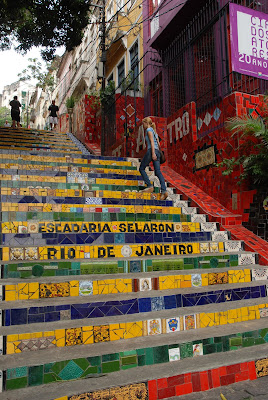
Another postal box, the colour contrasts with the bright red tiles.

People from all over the world posted their unique tiles to this staircase. I searched around, there was no tile from Hong Kong. And the artist questioned me why I didn't bring him a tile!
Tiles from Buenos Aires, Argentina.

From Africa.

A 3D tile from Easter Island.

The artist's favourite painting subject, the pregnant woman in the favela.

If you see somebody dresses in red and keeps a Moustache who hangs around the colourful staircase, it will be a pity to not to take a picture with him.

ut
Rio, with its 10million population, is the third largest city in South America.
Famous for its yearly-held Carnival, Rio is morn than its bad image in movie, The City of God. Modern though relaxing, huge though easy getting around by bus and metro. On the contrary, its beautiful beaches hide danger of mugging and its favela(Slum) is still a problem.
Copacabana beach. As it is famous for robbery and mugging, so I just took my small camera with me.

Old building in the city centre.

Beautiful street in the city centre.

The most famous sightseeings in Rio are definitely the Pao de Acucar(Sugar loaf mountain) and Corcovado where the biggest statue of Christ stands.
The expensive cable car, with the backdrop of the cloudy Sugar Loaf.

Though the weather was nice before I reached the mountain, the Sugar Loaf and the Christ on the opposite direction were both veiled in clouds.

After sunset, if offered spectualar view over the famous Copacabana Bay.


After visiting the Sugar Loaf, a few days later, I went to Corcovado. As the weather over the hill (it is only 710m) was unpredictable, even though the weather of the beach and the city was nice, the hill was heavily surrounded by clouds.
The equally expensive tram to the top of the hill. I find that the government of Brazil is really a money sucker.
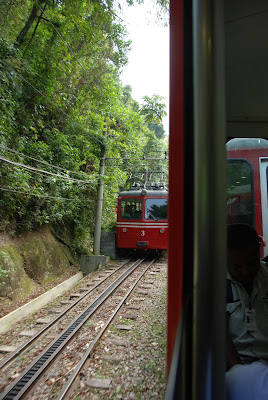
With great expectation, even though I waited for 3 hours, hoping the clouds would be cleared. The best glimpse of the Christ was like this.

The top of the hill should offer a 360 degree fantastic view of Rio, but the weather was so bad that even the flower in my hands lost its bright colour.


