23.5.15

The truth behind earthquake relief work

It looks romantic for doing relief work, but it actually consumes lots of time and energy.

 “I thought I would be driving into the disaster area with my motorbike like a hero, looking into the suffering of the earthquake victims and passing the relief materials directly into their hands.  But when we arrived, we found that the village had already got lots of supplies from different organizations.  At the end, we added the bag of rice and some medicines onto that piles of materials and left.”  My Colombian friend told me that he and his friend had hired a motorcycle and a taxi to deliver the relief materials after the earthquake.  And the above description was his romanticized image about earthquake relief work.

After doing relief work for three weeks in Nepal, I realized that many people had this kind of romanticism about relief work.  And what I want to say is, to do relief work, especially in Nepal is not romantic at all, it is even frustrated sometimes.

While carrying out the relief work for Light on Nepal, the goal of me and Edventure Nepal Children’s home is to give the victims relief, but not affecting their lives and living style.  Besides, we are also very cautious while carrying out our mission so as not to endanger the future development of Edventure Nepal.

The epicenter, Gorkha is a very big district, the distance from one house to another is very far.

Gorkha is our focus area (it is one of the 75 provinces of Nepal and its total area is 3,610sq. Km), as it is a remote mountain area, villages and houses scatter across different hills and slopes, it normally takes at least a few minutes to walk from one house to another.  The goal of our relief work is to locate the victims who need more support and deliver our aid.  In the situation of Gorkha, we depended on the locals heavily in giving us information.  Luckily, Edventure Nepal has got the help of the local social workers and other active villagers, otherwise, we would not be able to get the names of all the victims, as well as the damage situation of their houses.

Before we announced how to distribute the relief materials, the villagers had already crowded around our bus.

Usually, we would know beforehand how many families were there to get our relief materials.  Say for example, there would be 100 families, but every time when we arrived, we would find there were 100 extra families who came because the news spread from one village to another.  As we didn’t know anything about these extra families, we could not define they were the victims of earthquakes or just villagers in poverty.  And these extra families would usually cause chaos while we were distributing the relief materials because they would try all the methods to get the supplies.  This kind of situation often caused us headaches, because we didn't want them to return with empty hands.  However, as we didn't prepare enough supplies for them, we had to figure out a way to settle the situation.  Fortunately, we had always invited lots of volunteers from the same village, as well as two to three volunteer policemen with guns to keep the order.

Luckily, we got the volunteer policeman to keep everything in order.

In the beginning of this month, while we were distributing the relief materials in Uttamntari, the chairman of Edventure Nepal, Amrit had come up a way to distinguish villagers who were really in need of support.  He divided the original package of relief materials into one or two more parts, only people who were really desperate, could get all the items including a tent, a blanket and 14kg of food, otherwise they could only get either one or two items.  In order to distinguish them, Amrit and other volunteers from Edventure Nepal would ask the detailed situation of each family.  Sometimes, Amrit would find the family was very much self-sustainable, such as their family members were working abroad or they had their own general store business.  Or they would find some drunken villagers came to ask for relief materials.  In these cases, we would rather distribute the supplies to other families who were more in need of help.

Such as on the 16th of May, we were in Annapurna, Gorkha, we were planning to distribute relief materials to only 450 families, but at the end, there were more than 550 families gathering around us.  Luckily, we had kind of expected that, so even after giving all the packages of rice and lentils to the 450 families, we would still distribute boxes of dry noodles to the extra families.  So at the end, everyone was happy.

Therefore, please don’t assume that it is an easy task to distribute relief materials, it actually requires lots of procedures, and consumes lots of mental and physical strength.  And we also don’t want the villagers would rely on charitable organization like us in the long run.

Volunteers of Edventure Nepal were working diligently under the sun, writing down all the records of the victims.  And a lovely villager was sheltering him from the sun with an umbrella.

Further, there are lots of rules and regulations from the Nepal government.  For example, the Nepal government has restricted lots of charitable organizations to distribute relief materials to the victims directly, they would ask them to put their supplies into the government’s store houses for centralizing and make the distribution work more efficient.  However, at the end, how many supplies would really fall into the hands of the victims?  I really don’t know.

As a result, in order to really deliver the supplies directly into the hands of the victims without any administrative costs, we had to do lots of documentations and paper work in the request of the government.  Most importantly, we got the contacts from the local villagers who help us to coordinate with the local government bodies.  This is the reason why we could arrive and distribute the supplies easily and we were not restricted by the government.  We were cautious because we didn’t want the government would have any excuses to give any kinds of troubles to Edventure Nepal in the future.

Amrit was discussing how to distribute the supplies with the local social worker and the representative from the local government.

After doing volunteer work in Nepal for so many years, I still don’t understand the attitude of the Nepal government towards charitable organizations.   The government would actually regard this kind of charitable campaigns, especially earthquake relief work as a rare occasion to do big business.  Moreover, many people would think children’s homes such as Edventure Nepal has subsidies from the government.  I thought so too in the beginning.  But ironically, not only the government would not give them subsidies, they would waste more money in setting up different regulatory bodies and employing more people to control all the charitable organizations.  What for?  The motive behind is very clear, which is to “earn some money” in the names of carrying out rules and regulations.  Therefore, all the funds for local charities are always self-raised.

All in all, although there is a lot of bureaucracy while carrying out our relief work (I have to really thank Amrit for all of his dedication and help) which makes us sometimes frustrated, we really felt worthwhile once we saw the smiles of the victims and felt the warmth of the villagers.

An innocent kid from Gorkha.
While his mom was so busy taking the relief materials, this little baby boy was very busy doing all the mischief.
A sincere thank you from the victim of Gorkha.
I was so touched by the act of a very friendly villager from Annapurna, Gorkha who came to shelter me with her umbrella.
Thanks for all the board members of Edventure Nepal to be the volunteers of our relief work.

If you want to know more about our relief work, please follow our FB page:


20.5.15

Do We Learn to Live for the Moment, Only When the Sky Falls?

Houses seriously damaged in Gorkha, the epicentre of the 425 earthquake


At around noon on 12 May, I was in a restaurant in Pokhara. Just as I was looking at the menu, I felt some shaking coming from under my feet. Having experienced the 425 earthquake and a number of aftershocks, I knew clearly that it was an earthquake. I said to my friend instinctively, “Earthquake!” and ran to the restaurant garden.

I took it for granted that it would just be a small aftershock, but when the land shook - it felt dizzying as if in a rough sea just as I experienced on 25 April. I knew something was wrong and mumbled several times, “Oh my god!” Looking around, the canopy of a nearby restaurant was rocking violently, and the white spherical lampshades hanging under it were all jumping up and down. I checked if the garden was safe, and whether there were tall buildings around. At that moment, I only saw a few tall trees and, just when I was wondering whether to move to the more open lake, the shaking stopped.

The customers and waiters who had escaped from the restaurant to the garden looked at each other and were stunned by the violent shock. This time it felt similar as 25 April, although much shorter - presumably for only about 10 seconds. Later, it was learnt that the earthquake hit 7.3 on the Richter scale.

My friend was too shocked for words, but I was starving and ordered food as normal. I noticed that even after the 425 earthquake, I still believed that life and death were all destined, and would not let things prevent me from enjoying life. Had I not seen very bad things in life? No, but I had always been optimistic - I believed that if my time came, there could be an accident, even walking on the street regardless of an earthquake.

We were surrounded by the earthquake victims as we distributed goods in Uttamtari, a small village in the epicentre.

My friend started to reflect on life - he realized that death could really come to us anytime. He said, “Yet so many people in this world delay seeking happiness! For example, many of my peers went through a year’s tough training at work after graduation. They thought: ‘I would be free and happy after a year.’ However, after a year, they wanted to get hold of the golden opportunity after the training to look for a good job. They would think: ‘After working for a period of time and earning enough money, I would be happy!’ He thought that these people were deceiving themselves - the happiness that they imagined might never realize as death might occur any moment.

I asked, “If you were to die soon, is there anything you regret or you want to do?” He replied, “No regrets, but if I really were to die tomorrow, I would like to call some special ones and chat with them.” I said, “I think you should make these calls now.”

One of the mottos in my life is: “Live each day like the last day.” So if I were to die now, I have absolutely no regrets.

The clear eyes and the genuine smiley faces of the villagers were not at all affected by the earthquake.

Perhaps in our life, there are many things that we want to do - to change the world, to change the people and the things around us, to change history, to change all the things that we do not like. However, if we were to have only one day of our lives left, what we would want to do would basically relate to us… to express to those we love how much we care about them, to do what we enjoy the most, to have our favorite meal, to spend this last day in the way we like the most…

Therefore, all the changes in fact come from within - only when we accept ourselves, and do not limit ourselves as to what to do, say, or how to express ourselves, will we see the world changing in the way we would like it to be, and start to like the people and the things around us, and stop blaming. Then, we should all be able to die without regrets, and have no fear wherever we are, earthquakes or no earthquakes.

As time passes, we store up more and more fear, and can hardly live for the moment. Looking at the smiley faces of the little angels in the children’s home every day, not at all affected by the earthquakes, I hope to inspire everyone through their smiles to live for the moment.

Thanks to a former Hong Kong volunteer for getting these little angles the jerseys with their names printed on them; all troubles are far away just looking at their smiling faces.


Translated by Elaine.

18.5.15

What can you do for Nepal if you are not there?

 Thanks to Edventure Nepal, a children’s home in Pokhara, for helping to distribute the relief materials smoothly.

After the earthquake on 25th April, since, first I was in Kathmandu, and second, I had been a helper in a local orphanage for years, I immediately started fundraising on social network (Facebook) for relieving the victims.

During this period, besides receiving the donations from all around the world, no matter whom I know in person or not, I had also received some questions about helping Nepal in person.

Let me take a chance here to explain further about my background and what I had carried out here.
My experience in Nepal had allowed me to search for and get locals’ help as well as to obtain the most updated local information since I had been a volunteer in Nepal for years. I started volunteering in a children’s home (Edventure Nepal) in 2011 and organising workcamps with Voltra (a Hong Kong charitable organization specialize in international volunteer services), called Love and Light, which had already brought 57 volunteers from Hong Kong to Edventure Nepal.

In addition, my social network built before had helped a lot since I was a finance reporter of a Hong Kong newspaper after graduated from journalism. And I am also a writer with three books as well as a travel blogger.

Therefore, I, during this period, mainly focused on the connections with internationals, Nepali rescue teams and any individuals who were concerned. I was also responsible for fundraising, publishing the threads on the Internet and carrying out the first-hand report here.

Apart from the above, I had realised that I may not be as helpful as I expected in some cases. Taking the relief material delivery two days ago as an example, the 11 members of Edventure Nepal were responsible for all coordination and communications with local authorities, police and victims since they got the language advantage; and in term of physical ability, I was not as strong as my teammates for carrying heavy things and distribution. In fact, I could carry around 10 kilograms of things, but it is still a small thing compared with them. Therefore, my main responsibilities were doing interviews and photo-taking for updated information and records.

Sometimes I was also worried that volunteers like me would become a burden to them as we might need others to save us if we were in trouble. For example, the road condition was so bad due to the earthquake and the rainfall to the disaster area on the first day, I was so afraid of the possibility of car accident. Luckily, my teammates, all the volunteers and the driver, were all Nepalese, they knew the situation well and the way to handle if any accidents happened.

Everything about our delivery went smoothly, however, we cannot always take luck for granted. Some of my foreign friends experienced another story. They rented a taxi and a motorcycle to deliver the relief materials to the affected area without detailed planning, such as coordination with locals and also no inspection beforehand. Therefore, they found out that there was enough help from the government and other organizations already. They, at the end, could only put the relief materials together with the stacks of stock which was already delivered there.

Thankfully, with the help of the volunteers of Edventure Nepal, we could coordinate with local authorities and police and inspect the situation of the affected area before delivering our help. At the end, all the relief materials had been successfully delivered to the villagers without any administrative cost.

We had already coordinated with local authorities, police and social workers before delivering our help.

Endless assistance from Edventure Nepal’s members.

It was very important to have Nepalese volunteers to lead the team because they know the local language and familiar with the situation.

So back to the topic, how can you help Nepal if you are not here? Frankly speaking, if you are not an expert knowing how to rebuild
 quake proof houses, but are just eager to help, there is nothing you can help and you may actually become a burden to the others. Because for us, other than doing relief work, we will need to spare extra time to take care of foreign volunteers, to arrange their transportation, meals and accommodation. Due to the current situation, these are not on our priorities.

Besides asking for helping in person, donation of stuff is a popular question to us. We do need some stuff, however, it is now so difficult to transport them. A lot of them have arrived the Kathmandu airport by air and cracks occurred on the runway since an influx of material imports had exceeded the usual amount and reached the limit. The Nepal government also does not have enough manpower and resources to deliver the materials to the disaster area and this makes nearly all of them are hoarded. At the moment, we prefer to buy some necessaries locally and only call for stuff donations when the local logistics improves.

You actually can give a hand in different ways even you are not in Nepal, such as joining fundraising events in Hong Kong, connecting us with international networks, translating articles, carrying out administrative work, updating information on various platforms, handling the post-sale logistics of my charity book sales. Some people are quite passionate and organised different activities after the earthquake in order to raise the fund, namely the charity buffet of Morocco Restaurant in Cheung Chau and the ad-hoc fundraising for Nepal initiated by Mr. Kwong Kwok Wai, and helped by volunteers in the event Living Cheung Chau. One of my friends is going to organise a Music Night to raise the fund too.

We may, after a period, recruit some helpers to rebuild habitats for the victims, but for right now, we need to have enough money for buying basic rescue items and rebuilding their houses later before having volunteers coming here.

If you wish to donate money, I strongly suggest that everyone should take a look if your money will be contributed effectively, like if your money will go directly to those in need, or if the organisations you want to donate have cooperation with any local organisations. Many overseas groups that wish to come to help have got rejected by the Nepal government due to the local restriction and regulatory for overseas charities. In my opinion, the Nepal government should alter the rules under this post-earthquake situation. This act, upholding the rules and regulations, regardless of the situation, has made many countries cannot join the aids in time.


You may have thought of donating money to the Prime Minister’s National Relief Fund (PMNRF) and wonder if it is helpful. My answer is, “I doubt.” The Nepal government is known for its corruption and disregards their citizens’ public critique about their corruption, inefficiency, incompetence and bureaucracy throughout the up-to-now rescue in the country. A local from Gorkha mocked the government’s rescue that, a few days ago, a helicopter put down 1 tent and 3 bags of rice to a nearby village, then left with a bill of USD25, 000 in the spending record. The locals regarded this as one of the sarcasm and were not surprised at all. It was not the first time. They now can only wait for aids from non-profit charities, as they never expect the government will come.

Not only Edventure Nepal has started fundraising for Nepalese, but also many individuals in Nepal are doing the same in order to buy goods and deliver them to the victims directly. Before making donations, you may search some more information for different parties that are helping in Nepal.
It was a joy to us seeing the smiles of victims after receiving our relief materials.


If you are interested to know more about our relief work in Nepal, please refer to our FB page: Light on Nepal

Translated by Sandy Chu.

12.5.15

The villagers’ smiles had melted my heart


The beautiful Gorkha village before earthquake


­­Gorkha Dhale Bar on 29th April

On this day, Amrit, other children’s home leaders and me bought some basic materials and rented two jeeps and one mini-van for the trip to a village called Dhale Bar in Gorkha, the epic centre of the earthquake this time.


On the way to the village near the epic centre

It took around 4 to 5 hours from Pokhara to Dhale Bar Village. When entering Gorkha, we had seen a number of houses damaged by the earthquake. We drove to the mountain area with a local’s guidance. Since the road condition was very bad due to the earthquake and rainfall, our jeeps got stuck in mud for few times and the trip was very bumpy making us bouncing inside the vehicles.


Our fleet driving into the disaster area

 It was 6pm when we arrived the first house damaged severely. After understanding the situations of affected villagers, we distributed the food, clothes, tents, mats and other necessary materials to the two most affected families. We also met a local police, who was in a navy blue military uniform, and he came here for acquiring more post-earthquake information. He had visited other villages before arrived Dhale Bar.


Houses severely damaged in Dhale Bar village

Near 200 houses damaged in Dhale Bar vaillage

We continued going up the hill, unfortunately, it rained heavier and heavier, so we stopped at a nearby school. A group of villager soon ran to us. One of them was quite agitated and kept asking us to see his damaged house. We walked to the place and looked around the houses, we have decided to gather the most influenced victims here for material distribution. Thankfully with the record made by the police, we delivered materials to another 23 the most affected families according to the list. Up to that moment, around 200 houses had been known as completely ruined. With the constraints to the remote area, we deeply believed that more villagers were awaiting for the aids and no one approached them yet.


A total of 25 families had basic emergency materials delivered

When I was taking photos for record, I saw a few curious children wandering in the crowds. A girl kept staring me with her big round eyes, I smiled at her and she smiled back. After knowing her name is Smita, she kept standing next to me. I put my arm on her shoulder, she sometimes looked up at me, a silent connection has then been built up. I was happy for her as she told me she had education with the help of Amrit’s translation. Smita was quietly playing my braid when another young villager, Hari, came for greeting and saying thank you to me.


The little girl, Smita, standing next to me all the time (The youth on the right: Hari)

I felt a bit embarrassed when Hari kept saying “Thank you.” to me but his smile has touched me. He showed some pictures of his beautiful village, Dhale Bar, on his mobile phone. “Have a look! This is the mountain range of Annapurna.” “Look at there! My house is on this small mountain.” He showed me the pictures excitedly, however, it was late and time to leave. Hari looked reluctant to farewell and say, “Please do come back!” and Smita just stood looking at me with her big round eyes.


Hari pointed to the mountain and said: “Look at there! My house is on this small mountain.” (Photo provided by Hari)

I gave some biscuits to Smita before getting on the car. I waved my hands to farewell them.  Their sincere smiles and on-going “Goodbye” had melted my heart.

This trip could be regarded as an inspection. The board of directors of the children home of Armit and I would keep supporting future rescue. We would buy all the necessary materials, depart for the village on the day after the following day in order to distribute the materials to whom did not receive any.

I, hereby, would like to thank to friends from all over the world with unconditional donations and many of them have even encouraged their families, friends and colleagues to support us. Morocco restaurant in Cheung Chau, Hong Kong, had also organised an all-day buffet on 5th May (Tuesday) for fundraising. Now, there have been more than 100 supporters, whom I know or I do not know, giving their hands to Nepal. I feel so grateful for the lovely Nepalese people as I know they are not alone but with a lot of support from many of us.

I will keep update the real-time rescue information and publicise the usage of the fund on FB page “Light on Nepal” (www.facebook.com/lightonnepal).


Translated by: Sandy Chu


4.5.15

60 Hours after the Earthquake


When the Nepal earthquake took place on 25 April I was right in Kathmandu, ready to receive the 7 volunteers from Hong Kong who were originally scheduled to arrive that night for the Love and Light Workcamp. Who would have thought of encountering a massive earthquake that occurs only once in a hundred years (the previous huge earthquake in Nepal was 80 years ago).

A few days before the earthquake

After arriving at Kathmandu from Pokhara by bus on 20 April, I caught the flu the next day – it got serious and I was in bed for two days. Intestinal flu developed, and for two days I suffered from diarrhoea. I therefore didn’t move about much and was resting in the hostel most of the time. It was only until 24 April evening when two Hong Kong volunteers arrived early that I visited the local market with them on 25 April morning.

Close to noon when the big earthquake was about to happen, they were planning to go to Dubar Square. I decided to return to the hostel to rest as I had not fully recovered from the illness. On the way back, I dropped by a bookstore to check out some books.

The rocking moments

I was sitting on a low chair when suddenly I felt clearly that a thump of the heart of the earth. My intuition told me, “This is earthquake; run!” However, the apparently rationally trained mind said, “Impossible!” Very soon after, it was obvious that the heart of the earth started to pump continuously. I saw the bookstore owner getting up quickly and running towards the door. I instinctively dashed for the exit too – when at the same time I heard loud noises of books falling – I thought to myself: “Run faster or get buried in the books!”


Books in the bookstore all over the ground after the earthquake

It was not easy to run; it felt like standing on the deck of a rocking ship. I made my way to the door swaying from side to side, but the exit was small – I remember pressing my hand on the back of the bookstore owner in pink t-shirt, thinking: “Goodness, get out more quickly.” Luckily there were not many customers in the store, or we could have been trapped in it.

Outside the door was a road, and everyone had rushed out. There were screams and sounds of window frames swinging. As I swayed my way forward, a woman tourist for some reason tried to make her way back to the bookstore. I grabbed her and dragged her to the road, saying, “Beware the windows may fall down!” At that moment, her boyfriend hurried over too to protect her, and we swayed our way back to the centre of the road together.


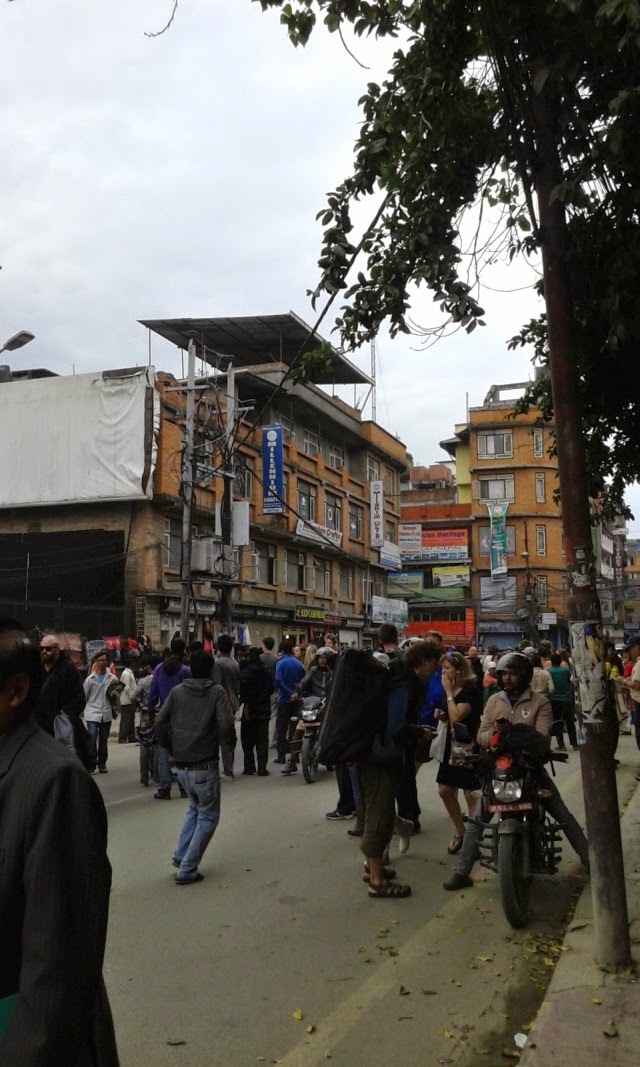
Everyone ran for the streets when the earthquake took place

The earth was shaking even more violently. I looked up and saw a dark sky, dust flying, birds fleeting, crows crying. I didn’t know how scared I looked, but the people around were petrified, and my heart was beating fast. I noticed that all the windows in the three-storey buildings on both sides were making creaking noises, and thought: “These windows may fall down anytime. Get out of here.” As I was going to move along the road, the earth stopped shaking.

12 hours after the quake

Where I was in the outskirts of Thamel, Kathmandu was one of the newer areas, and so only some of the lamp posts and walls had collapsed. On return to the hostel, I reunited with the two Hong Kong volunteers and learnt that they had a narrow escape. Looking at their photos, Dubar Square was seriously damaged; the monuments all turned into rubble!


Collapsed lamp post in the new area where I was located


The entire wall near the hostel fell down


Tower in Dubar reduced to flat land within seconds (photo by Franco)

We and many travellers in the hostel were in the lobby, trying to connect with the unstable internet network. My mobile 3G signals were on and off; there was traffic jam on the telecom network as I tried to call the chairman of the children’s home. At that point, to put safety the priority, the volunteering organization in Hong Kong and I decided to cancel the week-long workcamp. Fortunately, the 6 Hong Kong volunteers had yet to set off, although one volunteer was transiting in Kuala Lumpur and was stuck there due to the closure of the Nepal airport.

At dusk, a number of travellers took their sleeping bags planning to spend the night outdoors. At first, we had no such plan; but we ran outside in fear each time there was aftershock and, as there was forecast that there would be a strong aftershock that evening, we borrowed blankets from the hostel to spend the night outside. We were lucky that it was not too cold, and even when it rained at midnight it was only a short drizzle. So we felt rest assured staying outdoors on this day of the huge earthquake. Rest assured because even if there were a few strong aftershocks throughout the night, we could get back to sleep after having been shaken awake as we were already outside.


My yoga mat proved useful for spending the night outdoors

24 hours after the quake

At 6:30am on 26 April, we unexpectedly ran into the minivan driver hired by our workcamp. I had not been able to get in touch with him since the network could not connect. After discussing with Amrit, we decided to postpone our departure because even if we were to leave Kathmandu on the day, there might still be landslides from aftershock on the road to Pokhara. The two Hong Kong volunteers wanted to return to Hong Kong immediately, and so we parted ways. I went with Amrit to stay at his sister and brother-in-law’s.

Their home was in a new residential area outside of the town centre, and was not much affected. Several buildings, with their foundations having been affected, did not look straight, while the rooftop of one building had a large piece of cement hanging in the air. Even so, the residents of the area all camped out in fear of damage that might be caused by aftershocks.


Residents with homes that they could not return to


Deeply touched by the residents’ donating blood courageously

It felt warm to see Amrit’s big family of nine, together with several neighbours, helping each other out – cooking and eating together, and camping in the same tent. When they gave me the freshly prepared hot Dhal Bhat (lentil rice and vegetables, a local main meal), I was moved. That was my first proper meal 24 hours after the quake.

36 hours after the quake

For the entire afternoon that followed, we for fear of aftershocks stayed in the tent like camping and picnicking in the countryside. What was different was that during the occasional aftershocks, people ran out of the tents in panic. All we talked about was related to the earthquake, and we kept paying attention to the news on the radio. The area was out of electricity and running water, and the network disconnected often. We only managed with difficulty to charge our phones, to keep in touch with the outside world.

It rained in the evening and the temperature dropped substantially. My thoughts were with the people in Nepal whose homes had been destroyed, hoping they could find shelter. On the other hand, those of us here with homes that could not be returned to were not too comfortable either. 20 people hid in a tent, with the rain reducing the area in which we could sleep. We had to share 3 blankets among the 20 of us on this cold night.

48 hours after the quake

When at last it was dawn – after having been “shaken up” for a number of times by aftershocks – I was grateful beyond words when I saw the first sunrise after the earthquake and it was all sunny and bright. It was not an easy thing to be alive!

The aftershocks reduced in the afternoon, and Amrit, his brother’s family and I decided to return to Pokhara. Amrit’s sister was worried, asking them in tears not to go, so that they could stay together safely as a family. Nonetheless, they decided to go back because Amrit’s mother was by herself in Pokhara.


Kathmandu in ruins on the drive to Pokhara

We learnt from the news that the relief work by the government was mainly in Kathmandu and had yet to reach the villages near the epicentre. As we were doing fine, Amrit and I decided to help by fundraising, in the hope of providing food, clothes and tents for the victims.

60 hours after the quake

After an 11-hour drive, we finally returned to relatively calm Pokhara and saw the ten little angels in the children’s home again. Two people died in Pokhara during the earthquake, compared with some 4000 (and still counting) in Kathmandu.


The little angels alive and well, not affected by the trauma of the quake

A journalist asked me: when to return to Hong Kong? I said, no plans yet.

When the Hong Kong volunteering organization asked if I would take the charter flight to return home, I declined without thinking.

I did not feel I wanted to escape from Nepal, but to go to the places in need and do my best to help with my money and effort. Why? Perhaps all these years of volunteering, travelling and living in different countries have made me realize deeply that I am part of the global village.

I replied to the journalist, “Nepal is my home.” “In fact, the world is my home.”

If you wish to help Nepal, a nice and lovely country, we are fundraising now to provide the locals who have yet to receive any assistance with food, clothes, tents etc. See for details: www.facebook.com/lightonnepal


9.2.13

The travel within: 印度小故事──Devapriya


與世界接軌,快樂廚房裡的總廚
Aligning with the world, the chef in the happy kitchen

Devapriya,二十九歲,美國
Devapriya, 29, USA

Devapriya於二十一歲時便已成為了一名RenunciateDevapriya had become a renunciate when she was 21.
雖然Shakti沒有打算成為Ashram裡的長期住客,不過在西餐廳廚房裡當總廚的美國人Devapriya卻早於十八歲時放棄俗世的一切,居住於Ashram裡,並於二十一歲時成為了Renunciate放棄世俗生活,於廟宇或Ashram裡生活者,有如佛教中出家的尼姑/僧侶),一轉眼,現年二十九歲的她已在這裡住了逾十年。
Although Shakti doesn’t consider being a resident in the ashram, the chef in the Western canteen, Devapriya, 29, from the US had long renunciated everything in the world at the age of 21 and lived in the ashram since she was 18.

我從零九年第一次來到Ashram,便對Devapriya有深刻印象,因為當年聖誕節時上演的歌舞劇Gospel中,她便是領舞的一員。當時她靈巧和優美地在台上踏步和轉圈的情景,至今我仍歷歷在目。她有著一股看透世情和專注的神情,但她的雙眼也令我想起了柔和的水。
Ever since I came to the ashram for the first time in 2009, I had a strong impression of Devapriya. Being the leading dancer in the Christmas opera, Gospel. I still remember very well of her skillful and elegant steps and turns on the stage.  She also had this piercing, focused look. She reminded me of water too. Her eyes. 
Devapriya曾於Ashram的聖誕歌劇Gospel裡演出。Devapriya had once played a role in the Christmas opera, Gospel.
自小習舞的Devapriya可算是Ashram裡所有舞蹈表演的主要排舞師。Devapriya started to learn dancing since she was young, so she is basically the main choreographer.

Ashram裡的Renunciates、住客和訪客也會一同參與Ashram歌劇的表演。The renunciates, residents and visitors in the ashram all participated in the opera performed in the ashram.
這天她邀請我到她在主廟頂層的房間進行訪問,我從來沒有來過這個供女性Renunciate居住的區域,拐了一個又一個彎後,我已在那如迷陣般的間隔裡迷路。當我找到她的房間時,已較預約的時間遲了十五分鐘,我不好意思地道歉連連,心裡則十分驚訝這個房間的簡陋和細小。原來在這不足一百呎的房間裡,共住了Renunciate!不過我心裡面十分明白,要能當上一個Renunciate她/他要過著簡樸的生活,也要慢慢但穩定地切斷塵世的綑綁
She invited me to her room at the top floor of the temple to do the interview. As I had never been to the female renunciate quarters before, making one wrong turn after another I was lost in this maze. When I finally located her room, I had already been late by 15minutes.  As I repeatedly apologized to her, I realized how small and bare this room was.   I also found that there were two renunciates living in this smaller than 100 sq feet room! However, it did dawn on me that in order to be a renunciate, one has to live a simple life, slowly slowly and steadfastly cutting off one's ties with the world.

我最好奇的當然是Devapriya為何在青春少艾之年便決定住在Ashram裡。外表溫柔但眼神堅定的她,聽罷我的問題微微一笑,並向我娓娓道來她十二歲時與Amma相識的有趣一幕。「當時,我母親在一年前便認識了Amma,其後的暑假她便決定帶我前往西雅圖的靜修營中見Amma在漠視我的反對下,我的母親仍堅持要我去見Amma,故於整段車程裡,我均在哭鬧及憤怒地踢著母親的司機座位。」
The thing which interested me most was why Devapriya decided to stay in the ashram at such a young age. After hearing my question, with a gentle but determined look, she smiled at me and started to tell me the funny story about how she met Amma when she was 12, ‘My mother had already known Amma for one year, so she decided to bring me to the retreat in Seattle to see Amma. Regardless of my opposition, my mother insisted that I come, however, and I ended up spending the entire car ride to Seattle crying and kicking the back of my mother’s seat.’

她莞爾道:「到達那靜修營後,我已經平靜下來。我從遠處觀看著Amma輪流擁抱著每一個人,心想:『嗯,她似乎是一個友善的女士……還有點點像聖誕老人。』當Amma對我微笑並給予我兩顆Hershey’s kisses朱古力時,我決定她正常的表現已符合我的標準。」
She added with a smile, ‘Upon arriving at the retreat site, however, I calmed down and began to observe Amma from afar. “She seemed like a nice enough lady… kind of like Santa Claus.” When Amma smiled at me and gave me two Hershey’s kisses, I decided that she was normal enough to pass even my standards.’

之後,Devapriya看了Amma的自傳,由於讀過了Amma的一生,明白到她奉獻了那麼多來幫助他人,故當Amma於同年十一月再來美國時,Devapriay已十分高興能再見到她。她形容這是令她一身難忘的經歷:「我當時在人龍裡,距離Amma只有幾呎之遙,剛巧看到一個年老的女士投進Amma的懷抱我甫看到她,便將其聯繫上我當時頻繁不止的噩夢中之受害人。她有著我印像中從集中營倖存者的外表十分瘦弱,要人扶助才能將其搖晃的身體投入Amma懷裡。Amma一看到她,便立即對她傾進無盡的愛──憐愛地掃著她的背和心口,以及輕觸她的頭髮。而這女士則情不自禁地在Amma懷裡嚎啕大哭,當身旁的人要把她從Amma懷裡帶走時,她更捉著Amma莎麗(印度女性傳統服飾)不放。」
Hereafter, Devapriya read the biography of Amma and aquainted herself with her life. She slowly began to see how much she was doing to help others in the world. So by the time Amma came to America in November, she was more than happy to see her again. She described this unforgettable experience, ‘When I was just a few feet away from my own hug, an elderly woman was brought to Amma from the side. As soon as I saw the woman, I immediately connected her to the victims from my own nightmares. She had the same appearance I would expect from a concentration-camp survivor. Thin and frail, she needed several people to help her shaking body into Amma’s arms. As soon as Amma saw her, she began to pour love onto the woman: stroking her arms, rubbing her chest, caressing her hair, the woman began weeping and murmuring to Amma. When Amma finally turned to hug the next person, the woman caught hold of Amma’s sari and refused to let it go.’

雖然當時Devapriya只有十二歲,但看到此情此景的她卻忍不住落下淚來。那一刻,她明白到Amma就是那一位能為世人治癒心靈傷痛的人。到Amma把她擁入懷裡時,Amma如出一轍地以那股相同的愛為她抹去面上的淚水。
Although Devapriya was only 12, witnessing this entire scene, she burst into tears. In that moment she realized that Amma was someone who could truly heal such wounds. A few minutes later, when she received her own hug, and with equal love, Amma wiped away Devapriya’s tears just as she had the elderly woman’s.

從此而後,Devapriya的生命已變得不一樣。她說:「此次經歷之前,我也只不過是一個普通的,關心的只是逛街購物、朋友、學校和化妝等。可是慢慢地Amma的照片便取代了李安納度迪卡比奧的海報;AmmaBhajans亦取代了Backstreet Boys的流行曲。」她亦開始時常心唸Mantra經文或祈禱文)及於睡前打坐。
From that point on, Devapriya had a transformation. She said, ‘Before this experience, I was just a usual teenager who only cared about shopping, friends, schools and make up etc. Gradually, Amma’s photos replaced the posters of Leonardo Dicaprio on my wall, my music changed from “Backstreet Boys” to bhajans.’ She then also started to chant her mantra and do meditation before bed.

因此高中畢業後,Devapriya很自然地搬到了印度的Ashram居住,並於三年後成為了Renunciate
Naturally after high school graduation, Devapriya moved to the ashram in India and she became a renunciate after three years.

這逾十年的Ashram生活在她的修行路上帶來了甚麼轉變呢?她認真地考慮了一遍後說:「最初來Ashram生活,是為了更接近Amma,以獲得更多她的愛。但漸漸地,我希望能夠如她一樣,跟隨她的教導,更多為他人著想。在Ashram裡除了能訓練我內在的力,我也希望能為這裡的慈善服務出一分力,在做Seva的同時,我也希望能發展我的慈心,奉獻自己更多,並為世人去除痛苦。」
What kind of transformation did she get on her spiritual journey after these 10 years of ashram’s life? She thought deeply and said, ‘First, we came to the ashram because we wanted to get love from Amma. But gradually, I become wanting to be like her, follow her example, and thinking of other people first. Ashram is like a training of my inner strength. I would like to help the charitable projects here. While I am doing Seva, I try to develop qualities like compassion, give more about myself, and to remove the suffering of the world.’

當然在Ashram裡生活會面對很多挑戰,Devapriya表示,之前會覺得自己很好人、有耐性、有紀律和謙卑。但甫住進Ashram裡,自己的缺點便顯露無遺,她舉例說:「打坐令我更加煩躁、祈禱減底我的虔誠、與其他人工作時令我更懶惰、更沒有耐性和更急躁。」
There are certainly lots of challenges in the ashram, Devapriya said at first she thought of herself as a nice, patient, disciplined and humble person. But once she started to live in the ashram, all her negativities were effortlessly pouring out, she said, ‘Meditation made me more restless; prayers reduced my devotion; working with others made me lazier, more impatient and more restless.’

在廚房工作的她,敍述了數年前一件令她印象十分深刻的事件:「某年十二月的某天,一切也像出軌的火車一樣一塌湖塗:我與切菜的人發生爭吵、第一次煮的米粉卻因時間和油均用罄而變成了『薯蓉』、廚房的人也各自因不同事件而在爭執。到晚上十時半我終於完成工作,癱瘓地坐在廚房裡,我當時極度毛躁,更不禁罵:『這些人怎麼吃得那麼多!』我完全忘記了自己身處Ashram,而把廚食一職當作是一項苦差。」
She recalled an incident when she was working in the kitchen a few years ago, ‘One day in December while working in the kitchen, everything seemed to go wrong. I started out by getting into a huge argument with the veggie choppers. I then tried to cook rice noodles for the very first time, but ran out of both time and oil and it became like “Mashed potatoes”. Everyone else seemed to feel the same way, for as I looked around the kitchen, I saw several arguments going on simultaneously. At 10:30pm, I sat down, exhausted. I was fed up and so irritated, “Why people had to eat so much food!” In my mind, I was barely even aware that I was in Amma’s ashram. I only saw the kitchen as a place of duty, and the cooking as a difficult job.
由於Ashram住客和訪客眾多,因此Devapriya每日煮的也是「大穫飯」。As there are many residents and visitors in the ashram, so Devapriay has to cook a very big pot of food everyday.

身為西餐廳的總廚,Devapriya經常需要與切菜者合作。As a chef in the Western canteen, Devapriay always has to work with veggie choppers.

就在她暗自埋怨的當下,突然有人喊:「Amma!」原來Amma在旁邊的醫院探訪完病人後,順道來廚房視察。只見Amma笑意盈盈地出現在門口,她徐徐走進廚房走走看看,一把拿了放在桌上的花生吃,戲弄了數個人便離去。
Suddenly, someone shouted, “Amma!” In fact, Amma had left her room to visit someone in the hospital, and on her way back, stopped in the kitchen. I looked up and saw Amma standing in the doorway of the kitchen. She walked inside, smiled at everyone, and began to look around. On the table there was a bowl of peanuts, so Amma grabbed a handful, teased a few people, and then walked out the other door.

頃刻間,廚房的氣氛來了一個一百八十度轉變,本來在爭吵的人早已不計前嫌,興奮地討論著剛才發生的事,更把Amma剛剛吃剩的花生傳遞分享。Devapriya亦突然醒悟:「這不是單純的一份工作,我住在AmmaAshram裡,服務的對象均是Amma來自全球各地的兒女!」翌日,她以前所未有的精力和熱誠在廚房裡工作,她深深感受到,雖然外在的環境沒有改變,但Amma一個小小的舉動卻完全改變了她的內在態度。
In that brief moment, everything inside the kitchen changed. The people who had been fighting just a moment before began laughing and talking excitedly, sharing the remaining peanuts with each other. My gratitude caused me to remember that, ‘I was living with Amma, and feeding her children from all over the world.’ The next day she felt so much energy and enthusiasm while cooking, and continually reflected that although externally the situation was exactly the same, in that brief moment Amma had helped her shift her inner attitude.

DevapriyaAshram裡學懂裡以愛烹調。Devapriya learnt to cook with love in the ashram.

有人可能會覺得成為Renunciate的人自私,因為他們只顧自己修行和進度。不過Devapriya引述Amma的教導指:「Amma曾說,若一個人能持續其修行並獲得進步,他已令世界受惠。再者,Amma從來不容許我們只顧自己修行,相反地,她總要求我們要面對世界,並與Ashram外的人一樣努力工作,為世界作出最大貢獻。」
Some people may hold an attitude that being a renunciate is selfish, because they only care about their own spiritual practices and progress. On the contrary, Devapriya replied, ‘Amma says, if a person do their practices and advance, they have already benefited the world. Moreover, Amma taught us that we should not only care about our own spiritual practices, we should also face the world, work hard like everyone outside the ashram, so as to serve the world.’

Devapriya Chaitanya同樣也是Ashram裡的Renunciates,她負責西餐廳,後者則負責西式café Devapriya and Chaitanya are both renunicates in the ashram, while she responsibles for the Western canteen, Chaitanya responsible for the Westen café.

事實上,這世上雖然有人住在靈性的社區,但他們的行為卻與靈修的本質背道而馳;相反,有人生活在俗世裡,卻在對身邊人給予愛和慈悲心。所以,其實「入世」或「出世」也無關重要。最重要是無論我們在哪裡,我們的心也能朝著那團代表最高真理和愛的永恆火焰。
There are people living in a spiritual community, but behaving quite contrary to the essence of spirituality; there are also people living in the world, but practicing love and compassion with people around them. Actually, living in or out of the world doesn’t matter, but wherever we are,  our hearts should turn towards the supreme, that eternal flame of truth and love.

Amma曾著Devapriya在美國的擁抱大會中演講,讓她與所有人分享修行的經驗。Amma sometimes asked Devapriya to deliver speeches in hugging programs in the US, so as to share her experiences in spirituality.