Huaraz is a very interesting region, besides all the trekking opportunities, there is also a very famous ruin nearby.
Just about 2 to 3 hours by bus, I arrived the town of Chavin, a small and nice town.

Acutally, compared with the importance of Chavin the 3USD entrance fee is really worth. This temple was built at around 800BC, much older than other ruin I have visited before, even much older than Kuelap. So the culture of Chavin is believed to influence the culture after that, like the region north of Huaraz until Chiclayo and south of Huaraz until Ica.
Chavin de Huantar.

Excellent formation.

The ruins of Chavin are also preserved very well, we can still see the carved stone heads, sculptures and pillars are in a very good condition.
The main temple in the ruins.

Entrance of the main temple.

The excellent carvings on the pillar. You can see the influence of Chavin to Huaca de La Luna. The carvings are very similar.

The main plaza, here was the place where all the riturals were being held.

The symbolic sculpture of Chavin.

Old tunnel in the temple.

Entrance of the tunnel.

The only symbolic head remained in the ruins. Others are all settled in museum.

Beautiful stone sculptures.


The other marvellous stone heads in the museum.

Other carvings in the museum.

Blessing.
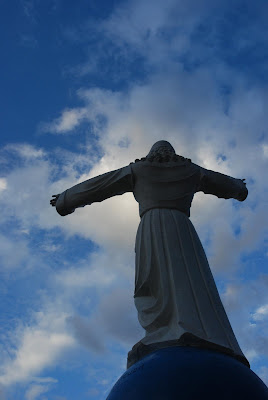
As Huaraz is situated in an excellent location, right between the wonderful Cordillera Blanca (the White mountain range) and Cordillera Negra (the Black mountain range), today it has become a popular basecamp for people who like trekking, ice-climbing and rock climbing etc.
The city of Huaraz is decorated with greenery.

However, just about 38 years ago, the beauty of the beautiful Cordillera Blanca had brought catastrophic incident to the region.
About 54 Km north of Huaraz, situated just at the foot hill of the higest peak Huascaran was the old Yungay, which was completely destroyed in 1970 because an earthquake triggered off a massive mud avalanche. Within 3 minutes, 20,000 people were buried under the land forever. Only about 100 people who escaped to the old cemetery (a small hill) were able to survive.
Nowadays, for the memory of the incident, the whole old Yungay has become a big memorial park, or a big cemetery more probably, with beautiful flowers planting all over the area.
The destroyed train has now become the monument.

Little girl was playing in the mud-covered catherdal.

The surviver of the avalanche told us how the tradgy happened.

The old cemetery which saved the lives of some of the people here.


Today, a new Yungay is rebuilt north of the old Yungay. Though without the brilliant scenery of the snow-capped Huascaran as the old Yungay had, there is a brand new and charming plaza.


The city of Huaraz is lucky, as the most obvious destruction by the earthquake in 1970 is the Catherdal, and it is still rebuilding.

With the heavy rain for the day before, day 4 was a super sunny day, but sadly this was our last day of trekking.
An incredibly blue sky.

The last day was an easy trekking, as we only needed to go downhill and it was just about 2 to 3 hours until we reached Cashapampa and took a car back to Huaraz.
Superb scenery.


Blue sky with bright moon.

As we trekked down, we meet lots of school children who were having school trip.

We even met villagers who were fishing.

Finally reached the gate of Cashapampa.


The quiet village, Cashapampa.


On the way back to Huaraz, we were able to see the peak of Huascaran(6768m), the highest peak in Peru.

Though our guide was not guiding though the whole trekking and our tents were leaking water inside, we had excellent food all the time (acutally, our guide was a cook, but not a trekking guide), brillant and responsible donkey assistant (so we only tiped the assistant, but not the guide) and wonderful members and scenery.
All in all, Santa Curz trekking is still my hightlight in Peru.
On day 2 night, we had a terrible night because of the heavy rain. And more miserable was that our tent was leaking water! This was only one of the lots of complaints we had after the trekking.
After the stormy night, a charming and pleasant morning was waiting for us.
Every morning was a great morning.

I forget the name of this great mountain, is it Apamayo?

Our guide was cooking breakfast for us in the cooking tent.

Actually, though the early morning was quite sunny, later it was getting more cloudy and it even rained for the whole afternoon.
So we set off at 8am to go for the mirador for the Laguna Jatuncocha and the basecamp of Rinrijirca.
There were two beautiful mineral blue and green lakes along our track, but unfortunately when we got there, it was raining so heavily.

Road to the basecamp of Rinrijirca.

The super clean glacier river.

As I was a little bit tired, I didn't carry on the way until the basecamp. It was also because our guide didn't tell us that it was worth to carry on, so we missed one of the highlights in our trekking - the incredible glacier lake Arhuaycocha - as I was told by some members who did carry on the trek.
Anyway, without knowing that we missed something, we carried on the route downhill towards the two lakes and our camping site.
As the trail mainly go downhill, so it was a pleasant walk...before it rained.
This lavender like flowers were everywhere on the trail.

The sacrify of cattle to the mountain?

When it started to rain, it became really miserable even though I had rain jacket because my pant was totally wet and cold after 4 hours of walking in the rain.
Another kind of beauty amid the heavy rain.


What more miserable was that as we trekked ourselves without our guide (actually no one know where was the guide), and our guide set up the camp in a hidden camp site this day. So we almost bypassed our camp site. Actually, if not one of our members looked back, we would never be able to rest in our tents with the hot coca tea after the long rainy hike.
But unfortunately, some memebers in our group really bypassed the camp site and walked until the next town which should be the hike for day 4.


